

Eriophorum latifolium Hoppe
1017660
Species
ISFS : 155400
Checklist : 1017660
ISFS : 155400
Checklist : 1017660
Contains :
Synthesis
Species description (© Flora Helvetica 2018)
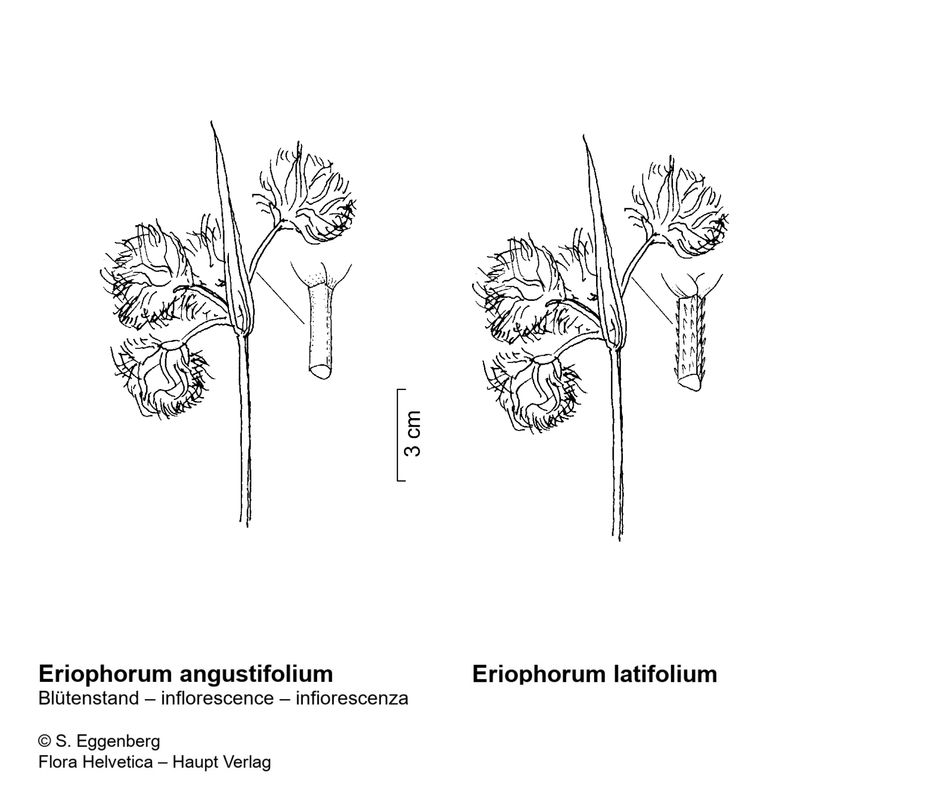
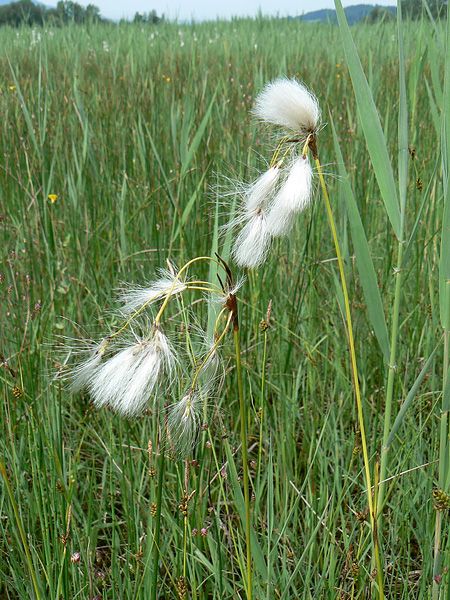
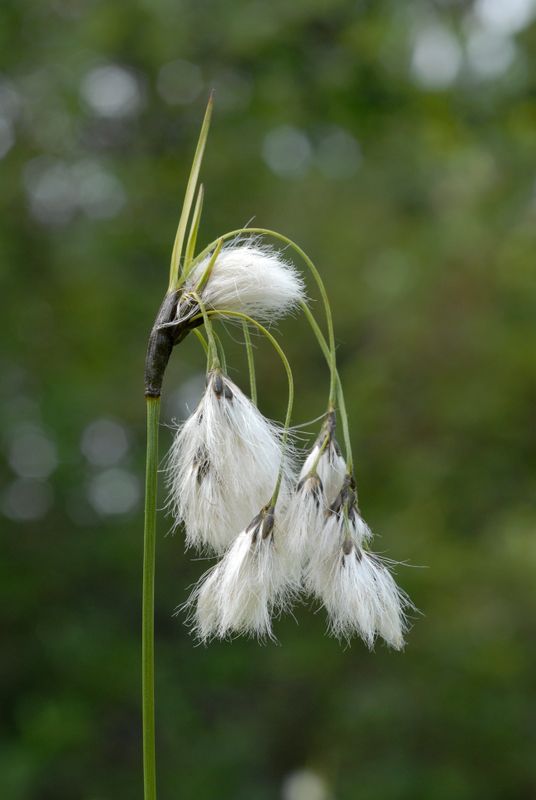
Stängel 20-50 cm hoch, stumpf 3kantig, ohne Ausläufer. Blätter meist flach, 3-8 mm breit, ohne Blatthäutchen. Ähren 3-10, ungleich lang gestielt, nach dem Blühen überhängend, von dunklen, hautrandigen, einnervigen Tragblättern umhüllt. Ährenstiele von vorwärts gerichteten Borsten rau. Frucht rotbraun, ca. 3 mm lang.Flowering period (© Flora Helvetica 2018)
4-5Habitat and distribution inside Switzerland (© Flora Helvetica 2018)
Kalkhaltige Flachmoore / kollin-subalpin(-alpin) / CHWorld distribution (© Flora Helvetica 2018)
EuropäischEcological indicator (© Landolt & al. 2010)
4+w+42-433.g.2n=58(72)Status
IUCN status
Least concernNational Priority
K - no national priorityInternational responsibility
K - noneConservation
Threats
Anatomy


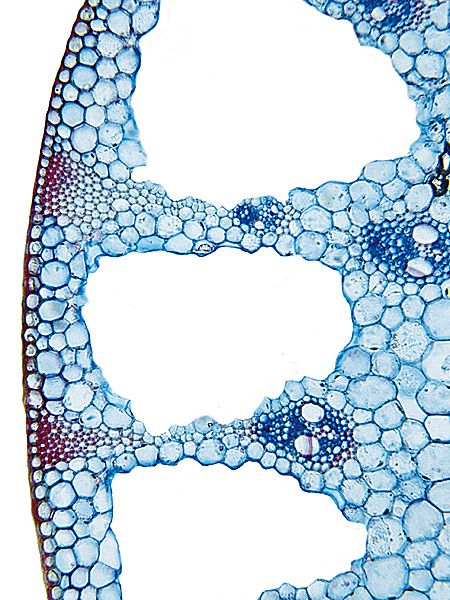
Summary of leaf anatomy (German)
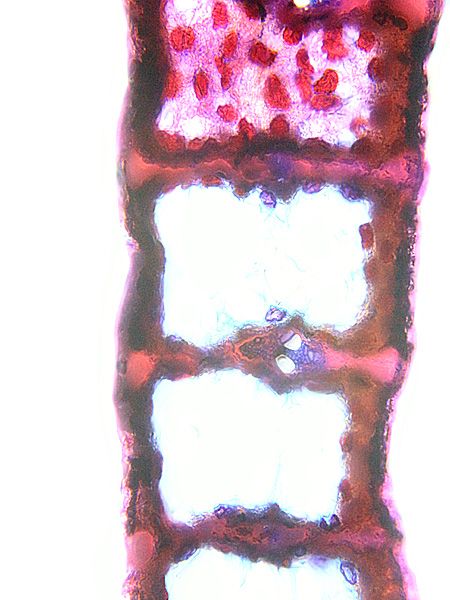
Obere Epidermiszellen grösser als untere. Versteifungselemente linienförmig am Blattrand. Verbindungs-Steg zwischen oberer und unterer Epidermis homogen verholzt. Leitbündel im Verbindungs-Steg in der Mitte eingebettet. Leitbündelhülle verholzt.Summary of stem anatomy (German)
Umriss rund oder oval. Leitbündel in mehreren Reihen. Konische Stützen. Grosse, unregelmässige Intercellularen. Epidermiszellen aussen verholzt.Description
Culm-diameter 2-5 mm, wall thin, radius of culm in relation to wall thickness approximately 1: 0.25 or < 0.25. Outline triangular, obtusely. Culm-center hollow and surrounded by many large thin-walled, not lignified cells. Epidermis cells thick-walled all around. Large vascular bundles arranged in one peripheral row. Small or rudimentary vascular bundles within the chlorenchyma. Chlorenchyma in round, oval, square or rectangular groups. Sclerenchyma belt absent. Groups of sclerenchyma conic. Vascular bundles collateral closed. Sheath around vascular bundles absent or not lignified. Vessels arrangement in vascular bundles in lateral position. Largest vessel in the bundle 20-50 μm. Cavities (intercellulars) between parenchyma-cells small, often triangular. Cavities (intercellulars) between parenchyma-cells round, oval or radial. Distinct cavities (intercellulars) in the protoxylem area of vascular bundles. Crystals absent.Distribution map
Habitat and distribution inside Switzerland
CHWorld distribution
EuropäischEcology
Life form
Geophyte
Habitats
Milieux Phytosuisse (© Prunier et al. 2017)
Habitats © Delarze & al. 2015
 | 2.2.3 - Kalkreiches Kleinseggenried (Davallseggenried) (Caricion davallianae) |
bold
Dominant species, influencing the appearance of the habitat
Character species
 Less strictly linked to a specific habitat
Ecological indicator values by © Landolt & al. (2010)
| Soil factors | Climatic factors | Salinity tolerance | |||
|---|---|---|---|---|---|
| Humidity Value H | 4+w+ | Light Value L | 4 | Salinity Index | -- |
| Reaction Value R | 4 | Temperature factor T | 3 | ||
| Nutriments value N | 2 | Continentality K | 3 | ||
- Ecological values legend
Humidity Value H 1 very dry 1+ dry 2 moderatly dry 2+ moist 3 medium wet 3+ wet 4 very wet 4+ soggy 5 submerged or underwater f plants living in running water u mostly submerged plants v partly submerged, partly floating plants w humidity moderately variable (± scale of 1-2) w+ highly variable humidity (scale exceeding ± 2) Reaction Value R 1 Very acid (pH 2.5-5.5) 2 acid (pH 3.5-6.5) 3 lightly acid to neutral (pH 4.5-7.5) 4 neutral to basic (pH 5.5-8.5) 5 basic (pH 6-5 -> 8.5 Nutriments value N 1 very low in nutrients 2 low in nutriments 3 medium-poor to medium-rich in nutrients 4 rich in nutriments 5 very rich in nutriments Salinity tolerance 1 halotolerant 3 halophyle Light Value L 1 very shady 2 shady 3 lighted areas 4 luminous 5 highly luminous Temperature factor T 1 alpine to nival stages (from the treeline to the snowline) 1+ suprasubalpine and upper subalpine levels (pine and larch forests) 2 subalpine level (coniferous forests without beeches up to the upper limit of spruces) 2+ lower subalpine and upper mountain stages 3 mountain level (beech and silver fir forests, in the central Alps Scots pine forests) 3+ lower mountain and upper hill levels 4 hill level (mixed deciduous oak forests) 4+ hot places, hill level 5 very hot places, hill level (only in the hottest places, typical of southern Europe) Continentality K 1 Atlantic (high air humidity, very low temperature variations, mild winters) 2 Sub-Atlantic (high air humidity, low temperature variations, relatively mild winters) 3 sub-Atlantic to subcontinental (average air humidity, moderately variable temperature, slightly low winter temperatures) 4 subcontinental (low air humidity, large temperature variations, rather cold winters) 5 continental (very low air humidity, very large temperature variations, cold winters)
Water dependency
| Rivers | |
| Calm water | |
| Ground water |
Nomenclature
Accepted Name (Checklist 2017)
Eriophorum latifolium Hoppe
Vernacular name
Deutscher Name :
Breitblättriges WollgrasNom français :
Linaigrette à larges feuillesNome italiano :
Pennacchi a foglie largheMatch with other reference books
| Relation | Nom | Book | No |
|---|---|---|---|
| = | Eriophorum latifolium Hoppe | Checklist 2017 | 155400 |
| = | Eriophorum latifolium Hoppe | Flora Helvetica 2001 | 2475 |
| = | Eriophorum latifolium Hoppe | Flora Helvetica 2012 | 2651 |
| = | Eriophorum latifolium Hoppe | Flora Helvetica 2018 | 2651 |
| = | Eriophorum latifolium Hoppe | Index synonymique 1996 | 155400 |
| = | Eriophorum latifolium Hoppe | Landolt 1977 | 431 |
| = | Eriophorum latifolium Hoppe | Landolt 1991 | 379 |
| = | Eriophorum latifolium Hoppe | SISF/ISFS 2 | 155400 |
| = | Eriophorum latifolium Hoppe | Welten & Sutter 1982 | 2398 |
= The taxon corresponds to the accepted taxon (Checklist 2017)
< The taxon is included in the accepted taxon (Checklist 2017)
> The taxon includes (among others) also the accepted taxon (Checklist 2017)
< The taxon is included in the accepted taxon (Checklist 2017)
> The taxon includes (among others) also the accepted taxon (Checklist 2017)
Status
Native status
-IUCN list of endangered species (© Walter & Gillett 1997) : No
Status on national Red List 2016
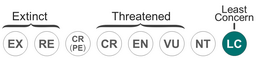
IUCN status:
Least concern
Additional information
IUCN criteria: --
Status on regional Red List 2019
| Biogregraphic regions | Status | IUCN criteria |
|---|---|---|
| Jura (JU) | LC | |
| Mittelland (MP) | NT | B2b(iii) |
| Alpennordflanke (NA) | LC | |
| Alpensüdflanke (SA) | LC | |
| Östliche Zentralalpen (EA) | LC | |
| Westliche Zentralalpen (WA) | LC |
- Legend
EX Extinct RE Regionally Extinct CR(PE) Critically Endangered, Probably Extinct CR Critically Endangered EN Endangered VU Vulnerable NT Near Threatened LC Least Concern DD Data Deficient NE Not Evaluated NA Not Applicable
National Priority Species List Status
| No national priority or international responsability |
Protection status
| International (Bern Convention) | No | |
| AG | total protection | (01.01.2010) |
| BE | partial protection | (01.01.2016) |
| GR | total protection | (01.12.2012) |
| JU | partial protection | (06.12.1978) |
| OW | partial protection | (01.04.2013) |
| Switzerland | -- | |
| SH | total protection | (06.03.1979) |
| TG | total protection | (01.01.2018) |
| ZH | partial protection | (03.12.1964) |
| BL | total protection | (01.01.2012) |
| GE | total protection | (25.07.2007) |
- Disclaimer
InfoFlora compiles information on protected species as accurately as possible, taking it from the respective cantonal laws. In some cases, however, it was not possible to use the plant names as listed in the original text, but an interpretation of their taxonomy or nomenclature was necessary. The exact meaning of the categories „completely protected“ and „partially protected“ differs among the cantons.
InfoFlora cannot guarantee that the information on the protection status is correct and complete. In case of doubts, we recommend to look up the texts of the respective cantonal law.
Status by sector of activity
| Agriculture-related environmental objectives : | L - | more informations |
| Forest management environmental objectives : | more informations |