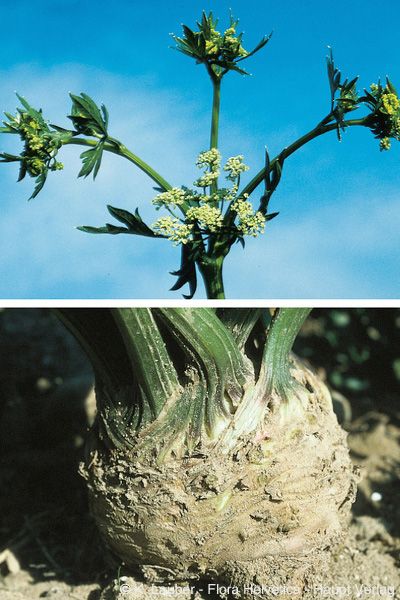
Apium graveolens L.
1004250
Species
ISFS : 38400
Checklist : 1004250
ISFS : 38400
Checklist : 1004250
Contains :
Synthesis
Species description (© Flora Helvetica 2018)
30-100 cm hoch, kahl, dunkelgrün glänzend, aromatisch. Blätter einfach gefiedert, Teilblätter +/- rhombisch, die untersten 3teilig, vorn tief gezähnt, am Grund keilförmig. Dolden 5-10strahlig, die unteren +/- sitzend, ohne Hüllen und Hüllchen. Kronblätter weiss oder hellgrün, ohne Ausrandung und ohne einwärts gebogene Spitze (nur bei der Gattung Apium). Frucht rundlich, abgeflacht, etwas eingeschnürt, kantig gerippt, Durchmesser ca. 1,5 mm.Flowering period (© Flora Helvetica 2018)
6-10Habitat and distribution inside Switzerland (© Flora Helvetica 2018)
Als Gemüsepflanze kultiviert und gelegentlich verwildert / kollin-montan /World distribution (© Flora Helvetica 2018)
Weltweit verbreitetEcological indicator (© Landolt & al. 2010)
4w44+442.k-t.2n=22Status
IUCN status
flora.fl.National Priority
--International responsibility
--Conservation
Threats
Distribution map
Habitat and distribution inside Switzerland
World distribution
Weltweit verbreitetEcology
Life form
Monocarpic hemicryptophyte, Therophyte
Habitats
Milieux Phytosuisse (© Prunier et al. 2017)
Habitats © Delarze & al. 2015
| NO INFORMATION |
bold
Dominant species, influencing the appearance of the habitat
 Character species
 Less strictly linked to a specific habitat
Ecological indicator values by © Landolt & al. (2010)
| Soil factors | Climatic factors | Salinity tolerance | |||
|---|---|---|---|---|---|
| Humidity Value H | 4w | Light Value L | 4 | Salinity Index | 1 |
| Reaction Value R | 4 | Temperature factor T | 4 | ||
| Nutriments value N | 4 | Continentality K | 2 | ||
- Ecological values legend
Humidity Value H 1 very dry 1+ dry 2 moderatly dry 2+ moist 3 medium wet 3+ wet 4 very wet 4+ soggy 5 submerged or underwater f plants living in running water u mostly submerged plants v partly submerged, partly floating plants w humidity moderately variable (± scale of 1-2) w+ highly variable humidity (scale exceeding ± 2) Reaction Value R 1 Very acid (pH 2.5-5.5) 2 acid (pH 3.5-6.5) 3 lightly acid to neutral (pH 4.5-7.5) 4 neutral to basic (pH 5.5-8.5) 5 basic (pH 6-5 -> 8.5 Nutriments value N 1 very low in nutrients 2 low in nutriments 3 medium-poor to medium-rich in nutrients 4 rich in nutriments 5 very rich in nutriments Salinity tolerance 1 halotolerant 3 halophyle Light Value L 1 very shady 2 shady 3 lighted areas 4 luminous 5 highly luminous Temperature factor T 1 alpine to nival stages (from the treeline to the snowline) 1+ suprasubalpine and upper subalpine levels (pine and larch forests) 2 subalpine level (coniferous forests without beeches up to the upper limit of spruces) 2+ lower subalpine and upper mountain stages 3 mountain level (beech and silver fir forests, in the central Alps Scots pine forests) 3+ lower mountain and upper hill levels 4 hill level (mixed deciduous oak forests) 4+ hot places, hill level 5 very hot places, hill level (only in the hottest places, typical of southern Europe) Continentality K 1 Atlantic (high air humidity, very low temperature variations, mild winters) 2 Sub-Atlantic (high air humidity, low temperature variations, relatively mild winters) 3 sub-Atlantic to subcontinental (average air humidity, moderately variable temperature, slightly low winter temperatures) 4 subcontinental (low air humidity, large temperature variations, rather cold winters) 5 continental (very low air humidity, very large temperature variations, cold winters)
Water dependency
| Rivers | |
| Calm water | |
| Ground water |
Nomenclature
Accepted Name (Checklist 2017)
Apium graveolens L.
Vernacular name
Deutscher Name :
SellerieNom français :
CéleriNome italiano :
Sedano comuneMatch with other reference books
| Relation | Nom | Book | No |
|---|---|---|---|
| = | Apium graveolens L. | Checklist 2017 | 38400 |
| = | Apium graveolens L. | Flora Helvetica 2001 | 1438 |
| = | Apium graveolens L. | Flora Helvetica 2012 | 1870 |
| = | Apium graveolens L. | Flora Helvetica 2018 | 1870 |
| = | Apium graveolens L. | Index synonymique 1996 | 38400 |
| = | Apium graveolens L. | Landolt 1977 | 2235 |
| = | Apium graveolens L. | SISF/ISFS 2 | 38400 |
= The taxon corresponds to the accepted taxon (Checklist 2017)
< The taxon is included in the accepted taxon (Checklist 2017)
> The taxon includes (among others) also the accepted taxon (Checklist 2017)
< The taxon is included in the accepted taxon (Checklist 2017)
> The taxon includes (among others) also the accepted taxon (Checklist 2017)
Status
Native status
-IUCN list of endangered species (© Walter & Gillett 1997) : No
Status on national Red List
| NO INFORMATION |
National Priority Species List Status
| National Priority | -- |
| Need to take action | -- |
| International responsibility | -- |
| Need to monitor populations | -- |
Protection status
| No international, national or cantonal protection |
- Disclaimer
InfoFlora compiles information on protected species as accurately as possible, taking it from the respective cantonal laws. In some cases, however, it was not possible to use the plant names as listed in the original text, but an interpretation of their taxonomy or nomenclature was necessary. The exact meaning of the categories „completely protected“ and „partially protected“ differs among the cantons.
InfoFlora cannot guarantee that the information on the protection status is correct and complete. In case of doubts, we recommend to look up the texts of the respective cantonal law.
Status by sector of activity
| Agriculture-related environmental objectives : | more informations | |
| Forest management environmental objectives : | more informations |